




A countable noun is a fundamental concept in English grammar, referring to nouns that represent items or entities that can be counted as individual units. These nouns have distinct singular and plural forms and can be quantified with numbers or specific determiners. To provide a comprehensive understanding, I’ll explain the characteristics, rules, usage, and examples of countable nouns, contrast them with uncountable nouns, and address common nuances, including exceptions and special cases.
What is a Countable Noun?
Countable nouns refer to objects, people, animals, or concepts that can be counted as discrete units. For example, you can count “books,” “dogs,” or “ideas” as one, two, three, and so on. These nouns:
- Have a singular form (e.g., one book) and a plural form (e.g., books).
- Can be preceded by numbers (e.g., “three chairs”) or quantifiers like “a,” “an,” “many,” “few,” or “several.”
- Are used with articles (“a” or “an” for singular, “the” for both singular and plural).
Characteristics of Countable Nouns
- Singular and Plural Forms:
- Singular: Refers to one item (e.g., “a pencil”).
- Plural: Refers to more than one item, often formed by adding “-s,” “-es,” or other plural endings (e.g., “pencils,” “boxes”).
- Some nouns have irregular plural forms (e.g., “man” → “men,” “child” → “children”).
- Use with Numbers:
- You can directly quantify countable nouns with numbers (e.g., “two apples,” “five cars”).
- Determiners and Quantifiers:
- Singular countable nouns require determiners like “a,” “an,” or “the” (e.g., “a dog,” “the cat”).
- Plural countable nouns can be used without determiners when referring generally (e.g., “Dogs are loyal”) or with quantifiers like “many,” “few,” “several,” or “a lot of” (e.g., “many students”).
- Question Forms:
- Use “how many” for countable nouns (e.g., “How many books do you have?”).
Rules for Forming Plural Countable Nouns
Most countable nouns follow standard rules for forming plurals, but there are exceptions:
- Regular Plurals:
- Add -s to most nouns (e.g., “cat” → “cats,” “book” → “books”).
- Add -es to nouns ending in -s, -sh, -ch, -x, or -z (e.g., “bus” → “buses,” “watch” → “watches”).
- For nouns ending in a consonant + -y, change -y to -ies (e.g., “baby” → “babies”).
- For nouns ending in a vowel + -y, add -s (e.g., “toy” → “toys”).
- Irregular Plurals:
- Some nouns have unique plural forms (e.g., “man” → “men,” “woman” → “women,” “mouse” → “mice”).
- Others remain the same in singular and plural (e.g., “sheep,” “deer”).
- Nouns Ending in -f or -fe:
- Some change -f or -fe to -ves (e.g., “leaf” → “leaves,” “knife” → “knives”).
- Others simply add -s (e.g., “roof” → “roofs”).
Examples of Countable Nouns
Here are examples across different categories to illustrate their use:
- Objects:
- Singular: A chair, a phone, a book.
- Plural: Chairs, phones, books.
- With numbers: Three chairs, two phones, five books.
- People:
- Singular: A teacher, a student, a doctor.
- Plural: Teachers, students, doctors.
- With quantifiers: Many teachers, a few students.
- Animals:
- Singular: A dog, a bird, a fish (note: “fish” can be singular or plural, but “fishes” is used for different species).
- Plural: Dogs, birds, fish/fishes.
- Example: I have two dogs and three birds.
- Abstract Concepts (some can be countable):
- Singular: An idea, a problem, a decision.
- Plural: Ideas, problems, decisions.
- Example: She has several good ideas.
Countable vs. Uncountable Nouns
To fully understand countable nouns, it’s helpful to contrast them with uncountable nouns, which cannot be counted as individual units and typically do not have plural forms.
| Aspect | Countable Nouns | Uncountable Nouns |
|---|---|---|
| Definition | Can be counted as separate units | Cannot be counted as separate units |
| Examples | Apple, book, car | Water, sand, information |
| Singular/Plural | Has singular and plural forms (e.g., book/books) | Usually singular only (e.g., water) |
| Determiners | A, an, the, many, few, several | The, some, much, little, any |
| Question Form | How many? (e.g., How many books?) | How much? (e.g., How much water?) |
| Numbers | Can use numbers (e.g., three apples) | Cannot use numbers directly (e.g., *three waters is incorrect) |
Note: Some nouns can be both countable and uncountable depending on context:
- Countable: “I ordered two coffees” (meaning two cups of coffee).
- Uncountable: “I spilled coffee on the table” (referring to the substance).
Usage in Sentences
Countable nouns are used in various sentence structures:
- With Articles:
- Singular: “A cat is sleeping.” / “The cat is sleeping.”
- Plural: “Cats are playful.” / “The cats are in the garden.”
- With Quantifiers:
- “Many students passed the exam.”
- “A few apples are left in the basket.”
- “Several cars were parked outside.”
- With Numbers:
- “I have three siblings.”
- “She bought ten pencils.”
- Negative Sentences:
- “There aren’t many chairs in the room.”
- “I don’t have any books on this topic.”
- Questions:
- “How many people are coming to the party?”
- “Are there any dogs in the park?”
Common Quantifiers for Countable Nouns
These quantifiers are typically used with countable nouns:
- A/an: For singular (e.g., a book, an apple).
- Many: For large quantities (e.g., many houses).
- A few: For small quantities (e.g., a few friends).
- Several: For a moderate number (e.g., several options).
- A lot of/lots of: For large quantities, informal (e.g., a lot of cars).
- Some: For unspecified quantities (e.g., some students).
- Any: For questions or negatives (e.g., Are there any chairs? / I don’t have any pens).
Special Cases and Exceptions
- Nouns That Are Both Countable and Uncountable:
- Time:
- Countable: “I’ve been to Paris three times” (specific instances).
- Uncountable: “Time passes quickly” (general concept).
- Paper:
- Countable: “I need two papers for the project” (sheets of paper).
- Uncountable: “Paper is made from wood” (material).
- Hair:
- Countable: “I found a hair in my soup” (single strand).
- Uncountable: “Her hair is long” (collective).
- Time:
- Irregular Countable Nouns:
- Some nouns don’t follow standard plural rules (e.g., “foot” → “feet,” “tooth” → “teeth”).
- Collective nouns like “family” or “team” are singular but refer to multiple entities and can take singular or plural verbs depending on context (e.g., “The team is playing well” vs. “The team are arguing among themselves”).
- Nouns That Appear Uncountable but Are Countable:
- Abstract nouns like “problem,” “idea,” or “opportunity” are countable because they can be quantified as individual units (e.g., “I have two problems”).
Common Mistakes with Countable Nouns
- Using “a/an” with Plural Forms:
- Incorrect: “A books are on the table.”
- Correct: “Books are on the table.” or “A book is on the table.”
- Using “many” with Uncountable Nouns:
- Incorrect: “Many water is in the jug.”
- Correct: “Much water is in the jug.” or “Many bottles of water are in the fridge.”
- Omitting Articles with Singular Countable Nouns:
- Incorrect: “I saw dog in the park.”
- Correct: “I saw a dog in the park.”
- Confusing Irregular Plurals:
- Incorrect: “I have two childs.”
- Correct: “I have two children.”
Practical Applications
Understanding countable nouns is essential for:
- Writing and Speaking: Ensures correct grammar in sentences, especially with articles, quantifiers, and plural forms.
- Learning English as a Second Language: Helps non-native speakers avoid common errors in quantification and agreement.
- Academic Writing: Ensures precision when referring to specific quantities or items.
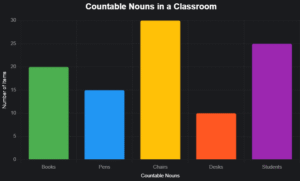
Visualizing Countable Nouns (Chart Example)
If you’d like a visual representation, here’s a chart showing the frequency of common countable nouns in a hypothetical classroom context. Let me know if you want a different chart or specific data!
Summary
Countable nouns are nouns that can be counted as individual units, with singular and plural forms, and can be used with numbers and specific quantifiers. They contrast with uncountable nouns, which represent substances or concepts that cannot be divided into separate units. Understanding their rules, exceptions, and proper usage is crucial for clear communication in English.
If you have specific questions, need more examples, or want further clarification on any aspect (e.g., irregular plurals, quantifiers, or exercises), let me know!